



Every Monday we share a quick “best of” from the week that was in the world of women’s health innovation with our Inner Circle members. What’s trending in the Femtech Insider community and beyond? Read on!
Trending
👉 FEMTECH IN SINGAPORE
Last week we shared the news of Ease Healthcare's $1.3M seed round. Ease is a Singapore-based women's health company focused on providing convenient, affordable and discreeet access to women's health services.
And although this is the first South-East Asian raise we've covered in a while there is a lot more to this emerging ecosystem and today we want to share some more insights and stats from the femtech ecosystem in Singapore with you.
Singapore’s healthcare system has been ranked as the top two in the world, with Hong Kong in the lead, for a number of years. It’s frequently referred to as the "miracle healthcare system" in terms of its efficiency, life expectancy and relative cost. Despite this polished system, a boom of health startups have appeared to address people’s desire for more judgment-free services. Particularly in the sexual wellness space, we see more startups within the last year offering at-home STD test kits and birth control delivery highlighting privacy and discretion as their main value-added.
According to data from fermata, 24 femtech companies currently operate in Singapore.
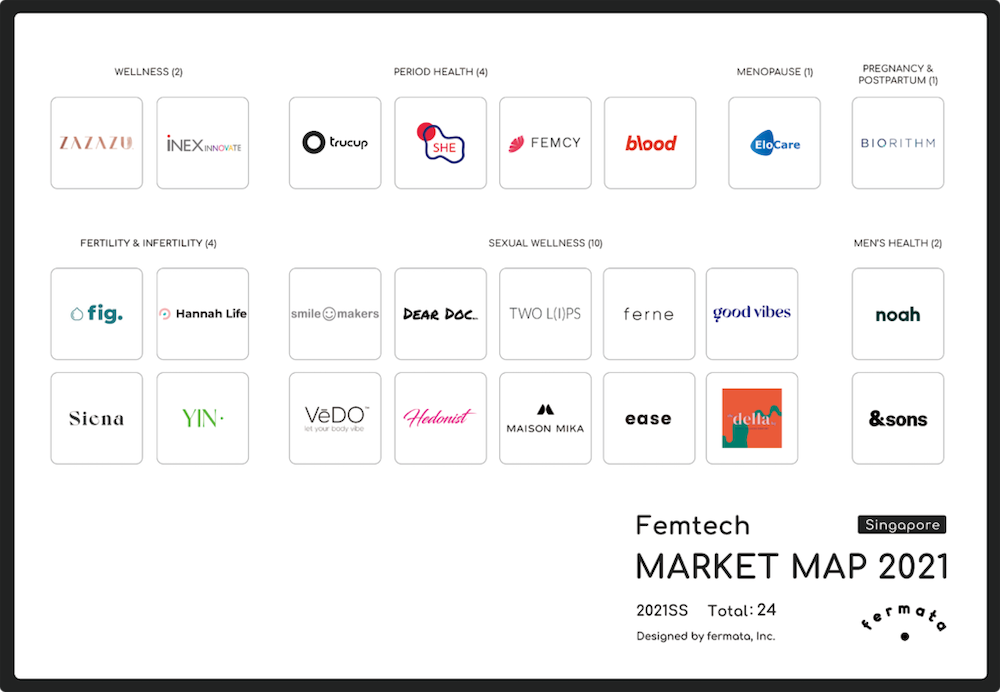
According to fermata's Francesco Geary "companies such as DearDoc, Ease and Ferne Health guarantee to provide something that a renowned healthcare system cannot when it comes to sexual health- open mindedness. There is still a heavy link of culture, religious and family honor tied to a woman's sexual health that can sometimes be present in a physical medical room, leaving women feeling ashamed and judged. This new idea of a sexual healthcare system allows women to feel as though they can take back control for themselves."Other femtech categories that are growing in Singapore are within period health and fertility care. However, there is scarce activity in menopause care, despite the country having one of the lowest fertility rates and is reported to be one of the most rapid aging populations in the world.
👉 MENOPAUSE AWARENESS MONTH
October is Menopause Awareness Month and since our coverage of Lisa Health recently announced collaboration with Mayo Clinic definitely got people talking last week we thought we'd share a short round-up of some of the successes we've been able to share by companies active in the menopause space:
Lisa Health received a research grant and teamed up with Mayo Clinic to work on novel tech for menopausal flashes.
Bia Care hired its first CMO! And no. The M doesn't stand for Marketing or Medical. Dr. Juliet Balfour became the company's Chief Menopause Officer a few weeks ago.
Elektra Health raised a $3.75M seed round and is putting the final touches on its "Meno-morphosis" program, which is expected to publicly launch in 2022.
Vira Health founder Andrea Berchowitz went viral with her TED Talk about Menopause and Gender Equality at Work.
Peanut, initially started as a "networking" app for new moms, launched new features and communities for women going through menopause.
Madorra Medical received FDA Breakthrough Device Designation Status for the treatment of vulvovaginal atrophy.
And on the pharma-side Bayer started Phase III development with an investigative non-hormonal treatment option for vasomotor symptoms during menopause after acquiring KaNDy Therapeutics last year.
Lots of activity and we're absolutely loving all the innovation and traction in a space that has been stigmatized ignored and underserved for so long. #happymenopauseawarenessmonth
Blast from the past: We took some time to catch up with the founders of Peppy, Elektra Health, Health & Her and See Her Thrive during Menopause Awareness Month last year. Have a listen!
Following
👉 FEMTECH AFRIQUE
Kay Ugwuede, a journalist previously covering African tech for TechCabal, is starting a new monthly newsletter all about Femtech in Africa!

The purpose of Femtech Afrique is to keep the femtech torch on the few companies already creating for and serving the African audience; to share the vision of their founders and the larger problems they are hoping to solve; and by so doing, not only document how the industry is maturing across Africa and other emerging markets but aim towards building a community around current and future happenings and actors in the sector."
👉 BREAST CANCER: THE BRAND
Hil Moss, a breast cancer survivor and journalist at STATNews thinks: Enough Pink! We're doing Breast Cancer Awareness Month all wrong.
Breast cancer is a unique case study in disease branding. Breast Cancer Awareness Month (BCAM), launched in 1985 by the American Cancer Society and Imperial Chemical Industries (now part of AstraZeneca, which makes several breast cancer drugs), was originally intended to encourage women to get regular mammograms. The momentum around breast cancer awareness continued in the early 1990s, when Evelyn Lauder (of Estée Lauder) established the Breast Cancer Research Foundation and solidified the pink ribbon as a universal symbol for the disease. The rest, as they say, is (very pink, very sparkly) history.
You might ask: A month dedicated to raising awareness for a pressing challenge in modern health care — what could possibly be wrong with that?
The answer is, to borrow a term coined by Breast Cancer Action, “pinkwashing.” What began as a strategic, research-driven, and ultimately effective fundraising approach has been co-opted by many in the name of profit.
Read the full story
👉 ARE WE DONE SAYING DIGITAL HEALTH YET?
By Lisa Suennen aka Venture Valkyrie:For ages I’ve been saying that the term “digital health” should be retired – that it is a bit of a lazy term that evolved around 10-12 years ago at a time when technology and healthcare rarely appeared in the same zip code, much less in the same enterprise. At that time, it was surprising to find healthcare functions operating in a digital world.
Healthcare and technology are now, finally, inextricably intertwined across many fronts. Healthcare is a highly diverse category and for eons we have categorized healthcare companies into their rightful sorts, none of which were called “digital health.” I believe the rightful categories are:
- health services
- health IT/tools
- medical devices & diagnostics
- biotech & pharma
So are we done saying digital health? As outlined above Lisa Suennen surely thinks so.
Investment Round-up
We've published our latest femtech investment round-up for September 2021. Check it out now and if you like you can access all previous editions of the round-up here.
And that's a wrap for today! 'Til next week!