



Every Monday we share a quick “best of” from the week that was with our Inner Circle members. What’s trending in the Femtech Insider community and beyond? We’ve got you covered! In this week's brief we talk about Consolidation in Digital Health, plus...
- Femtech meets DiGA
- Upcoming Event: How XR Is Transforming Healthcare (with Dr. Payal Gharnekar)
- Who's Building the Shopify of Digital Health?
- And more!
Consolidation in Digital Health 🤝
It truly seems like not a week goes by these days without us discussing some sort of M&A activity in this brief. Last Monday it was Kindbody's acquisition of Vios Fertility Network and only days later the news of the Nurx and Thirty Madision merger became the "talk of the town" in the digital health community as some argue that the market may be oversaturated with digital health companies many of which are creating similar solutions for similar health problems.
Are we in a digital health bubble? As per his recent LinkedIn post Dr Benjamin Schwartz sure thinks so. And here's why:
1️⃣ Unrealistic valuations."So far, 2022 hasn't been a good year for health tech companies on the public markets. A correction is needed to avoid real harm."
2️⃣ Healthtech is partying, healthcare is hurting."Every quarter in the past two years has been another celebration of digital health funding. Meanwhile, record numbers of frontline healthcare workers are burnt out and/or leaving the profession. We need solutions addressing this problem, not contributing to it."
3️⃣ COVID overcorrection."Brick-and-mortar's death has been greatly exaggerated."
4️⃣ Too many solutions in search of a problem."Solutions need to address real problems, need to appeal to doctors and patients, and (yes) need to have a sustainable business model."
5️⃣ Reality is catching up with hype."A great story will only get you so far. Eventually you need data."
"Digital health is due for a market correction. And that's not necessarily a bad thing. A more sensible, sustainable approach that brings real fixes, synergizes with traditional care, and values reality over hype will emerge. And the long-term movement will be better for it."
2022, a year of consolidation? Yep. You bet. Is this a good thing or a bad thing (for companies, investors, patients? Well... that remains be seen:

PS: CooperCompanies also announced the acquisition of Cook Medical's Reproductive Health Business. More on this next week. 👀 #medtech #morem&a #postpartumhemorrhage
Germany's DiGA meets Femtech 👋
Last week we talked about Lover, a sexual wellness digital therapeutic, that recently received FDA approval. This week we get to talk about another digital therapeutic targeting sexual wellness, more specifically vaginismus, that got approved for reimbursement through DiGA in Germany: Hello Better's Vaginismus Plus.
HelloBetter's Vaginismus Plus is a CBT-based 12-week program for women who struggle with (as the name says) vaginismus. Program cost is €599, which can now be reimbursed as the program has successfully completed the German government assessment procedure.
What is vaginismus? 🤔
According to the NHS “vaginismus is the body’s automatic reaction to the fear of some or all types of vaginal penetration. Whenever penetration is attempted, your vaginal muscles tighten up on their own. You have no control over it. Occasionally, you can get vaginismus even if you have previously enjoyed painless penetrative sex. Vaginismus does not necessarily affect your ability to get aroused and enjoy other types of sexual contact.” Treatment of vaginismus usually includes psychosexual therapy, relaxation techniques, pelvic floor exercises or vaginal trainers.
So what's a "DiGA" and why does it matter?
Per definition DiGAs are CE-marked medical device, that are medical devices of risk class I or IIa, whose main function is based on digital functionalities and whose medical purpose is achieved by way of this digital function. So essentially digital therapeutics as we like to call them around here.
The The DiGa database is essentially a collection of currently around 30 regulated digital health products reimbursed via the government’s fast-track program.
Femtech meets DiGa
"What about femtech?" you may ask as a reader of this brief. HelloBetter's Vaginismus Plus isn't the first digital health product targeting women's health listed in the DiGa database. Two other products have been added so far:
➡️ Mika by Fosanis targets cervical, uterine, and ovarian cancer. It's an app that uses CBT and other interventions to reduce stress after diagnosis and during therapy.
➡️ CANKADO PRO-React Onco by CANKADO was developed for breast cancer patients and allows them to record symptoms that trigger a prompt to speak to a doctor if needed.
More will likely follow as the German DiGa program matures. Definitely a space to watch especially for those looking to invest in digital health in Europe in the coming months and years. 🚀
Who's Building the Shopify of Digital Health?
Well... If Jan-Felix Schneider from HealthTechStack is to be believed it is them! 👇
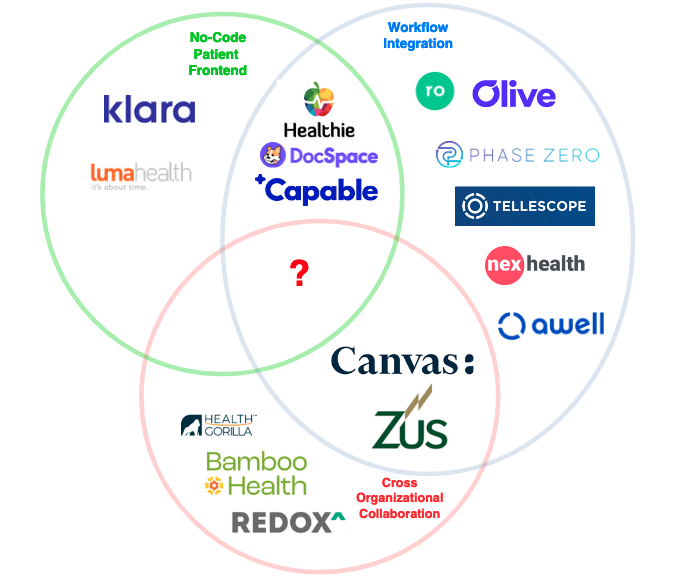
We've talked about the "digital health stack" before and frankly this is just another way to look at it, but nevertheless a great read and reminder that tech isn't the differentiator for many digital health companies who are entering the market these days (see consolidation ☝️) . It's really in the clinical pathways and outcomes as well as distribution aka business model.
So who's building the Shopify of Digital Health and what does that future look like? Health Tech Stack has the answer.


