

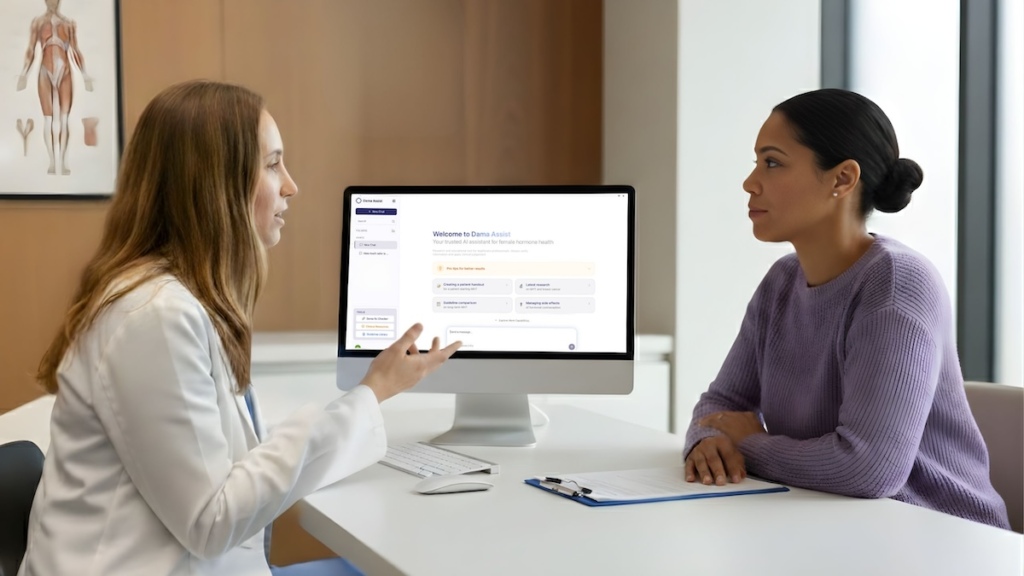
Dama Health, a healthcare intelligence startup focused on precision prescribing for female hormone health, has launched Dama Assist, an AI tool designed to help clinicians navigate the complexities of hormone care for conditions spanning contraception, perimenopause, and menopause.
The tool is aimed at individual prescribing clinicians in the US, offering evidence-based clinical decision support for hormone therapy management. It sits alongside Dama's existing B2B clinical tools and platform, which is embedded directly into clinic workflows.
The Problem
Hormone care management remains a significant gap in clinical practice. According to a survey by the Menopause Society, only around 31% of OB/GYNs reported having any training or module in menopause during their medical education. That leaves many clinicians uncomfortable identifying symptoms, dosing hormone therapies, and adjusting treatment when patients aren't responding well.
At the same time, patient expectations are rising. Women are arriving at appointments with symptom lists, supplement questions, and data from health apps, and clinicians are left trying to synthesize all of that information within limited consultation time.
"Women are coming to them with things they've seen online, and they're having to debunk and give them evidence on top of doing their day-to-day appointments," Rueda said, describing the feedback Dama has received from physicians. "They're overwhelmed."
How Dama Assist Works
Dama Assist is trained specifically for hormone care management. Unlike general-purpose AI tools, it has been built and continuously trained by Dama's medical team using clinical guidelines, medication databases, and proprietary medical consensus documents developed by expert panels.
Rueda pointed to research showing that even the best-performing general LLMs achieved only around 67% accuracy when tested on menopause-related clinical questions. "If someone doesn't go in and really train it and feed it good data, women's health - that lag that we had in medical research - is going to happen again in data and AI," she said.
The tool can identify patient risk factors, guides decision-making on specific therapeutics, formulation and dosing regime,, and generates evidence-based patient education materials at point of care. Clinicians are also using it to evaluate supplement interactions and create evidence-based content.
Dama Assist is designed as a self-service tool that individual clinicians can use independently, unlike Dama's existing platform, which requires integration into a clinic's workflow. This makes it accessible to the growing number of clinicians in the US who are leaving insurance-based systems and setting up independent practices.
Building Dama
Rueda, a medical scientist by training, first encountered the sex data gap during her dissertation work, where the majority of cell samples she was studying were male. She went on to work in pharmaceutical commercialization at Merck before co-founding Dama Health with Dr. Paulina Cecula, whom she met at Imperial College London.
"I had a spreadsheet with all the studies I could find - which dose, which side effect - and I became kind of the spreadsheet girl, helping my friends with their contraception side effects," Rueda said. "That's really where Dama started."
The company's mission is to end the trial-and-error method of prescribing hormone therapies, from contraception through to menopause and HRT. Dama's medical director is Dr. Aaron Lazorwitz at Yale University, where much of the company's pharmacogenetics research originates.
The team of around 12 is primarily made up of medical doctors, engineers, and scientists, operating between the UK and US. The company is at late seed stage, funded through a mix of government grants, and strategic investors. Dama was part of the Illumina accelerator and is currently part of the EMMA consortium - the Endometriosis Multimodal Management Application - funded by ARPA-H, the US government's advanced research agency for health.
Closing the AI Data Gap
Beyond the immediate product, Rueda sees a broader risk if women's health-specific AI tools aren't built with intent. General-purpose AI platforms aren't trained on women's hormonal health data, and as AI adoption in clinical practice accelerates, that gap will only widen.
"Generic LLMs - ChatGPT, Gemini - they're not built for women's hormonal health. They're not trained with that in mind," Rueda said. "If these tools aren't built with intent, they'll get good at general medicine, but they won't get great for women's health. That's what we're solving for at Dama."