


Every Monday we share a quick “best of” from the week that was in the world of women’s health innovation with our Inner Circle members. What’s trending in the Femtech Insider community and beyond? Read on!
#Trending
👉 WORLD CONTRACEPTION DAY
Yesterday, September 26, was World Contraception Day. World Contraception Day is an annual campaign to raise awareness for all forms of contraception, and advocate for better access and education around sexual and reproductive health.
Some stories we covered:
Last spring contraception review platform The Lowdown created a survey to get feedback from women on their experiences with reproductive and sexual healthcare. They received over 2,000 reponses. We shared the results and an interview with founder Alice Pelton. Learn more
PillClub took to the streets in New York yesterday under the motto: “Accessing contraception should be as easy as going to a vending machine.” So they got a vending machine, filled it with tampons, pads, condoms & co and placed it in New York. Learn more
Also part of Pill Club’s campaign were products from other women-led small businesses like Honey Pot Company, Awkward Essentials, Love Wellness and Medsur’s BCase. BCase, a case to attach birth control pills to one's phone, launched that day and we were lucky enough to interview student entrepreneur Sammie Hasen, who told us more about her product, company and vision. Learn more
Organon, the recently launched Merck spin-off focused on women’s health kicked off their first awareness campaign tackling unplanned pregnancy. Learn more
And last but not least U.S.-based Non-profit Power to Decide added telehealth to its abortion finder tool. Learn more
👉 FAMTECH & THE RISE OF PARENTING STARTUPS
Seven Starling’s $2.9M seed round got a lot of attention last week and their raise is part of a larger famtech trend, that also led to the creation of the Famtech Collective last year. Other notable rounds announced in the last weeks were German Keleya’s €3M Series A, Canadian Koble’s $1M pre-seed round, and Y-Combinator (S21) graduate Ruth Health.
Famtech Collective’s Member Directory helps to get a pretty good overview of companies active in the space.
#Following
👉 THE GENDER PAY GAP IN DIGITAL HEALTH
Exits & Outcomes shared some stats on the gender pay gap in digital health and clearly there’s lots of work to do…
Quoting Brian Dolan: After a reader asked, I took a look at the E&O Digital Health Public Company Executive Compensation Tracker to come up with a rough calculation of the compensation gap that exists between the women and men listed in the database. Of the 81 executives E&O tracks, 18 are women -- about 22 percent. The average total annual compensation for women on the list comes to a little more than $2.5 million. For the 63 men in the tracker, the average total annual compensation comes to a little more than $23.1 million. So, the digital health executive compensation gap between men and women is more than $20 million right now.
👉 "BAD NEWS" & DIGITAL HEALTH
Just last week we stumbled upon this 2019 STAT article again, that’s still one of the most popular ones on the site today: 23andMe had devastating news about my health. I wish a person had delivered it.
I had just gotten home from the gym when I opened the email from 23andMe, saying a report was ready for me to read. That click changed my life forever: To my utter shock, the results showed that I have a mutation in a gene called BRCA1, which puts me at a huge risk of developing breast and ovarian cancer. I broke into tears.There will be countless other women who, like me, are going to find out about their increased risk of breast cancer through an online report as opposed to sitting with a genetic counselor, which is how people find out when they do genetic testing through a health care professional. 23andMe replaces that one-on-one conversation with a digital tutorial that every user must go through before she or he can view results for any of the reports the company deems sensitive (such as tests for BRCA or Parkinson’s disease).
I hate to admit it, but I clicked through that tutorial without paying it too much attention.
A good reminder for all of us that tech isn’t the solution to everything in healthcare.
👉 WHY MID-SIZED CORPORATIONS MAKE FOR GOOD COMPETITORS AND PARTNERS
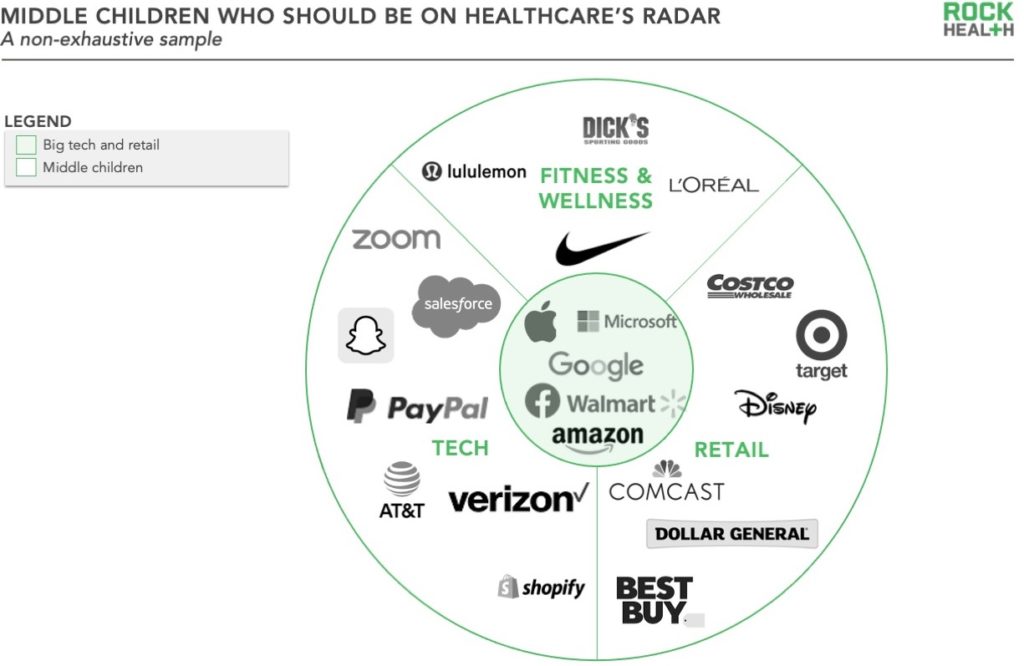
From Rock Health's recent report "Healthcare's middle children: Potential disruptors flying under the radar"
There has been a lot of talk about big tech and big box retail entering healthcare. Many incumbents are shaking in their boots at the prospect that is now becoming a reality. But a major, overlooked entrant into healthcare are the middle children: large retail, fitness, and tech companies that have not been labeled “big,” but are still a force to be reckoned with.
We call these players “middle children” because they are in between their big tech & retail older siblings and startup younger siblings. Perhaps they will also share middle children qualities that will set them up for success.
These middle children are both competitors and potential partners for digital health companies. They tend to be consumer focused, strong brands with big enough presence in a given market to really make an impact.
The middle children are motivated to enter healthcare by the same drivers that motivate their big competitors. The market opportunity is huge ($3.5T); healthcare is undergoing digital transformation; and the growing potential for healthcare consumerism.
These middle children have several distinct advantages as they enter healthcare:
- Smaller wins are big enough
- More irons in the fire
- Consumer loyalty, minus the baggage
- Assets often lacking in healthcare
- Innovative DNA