


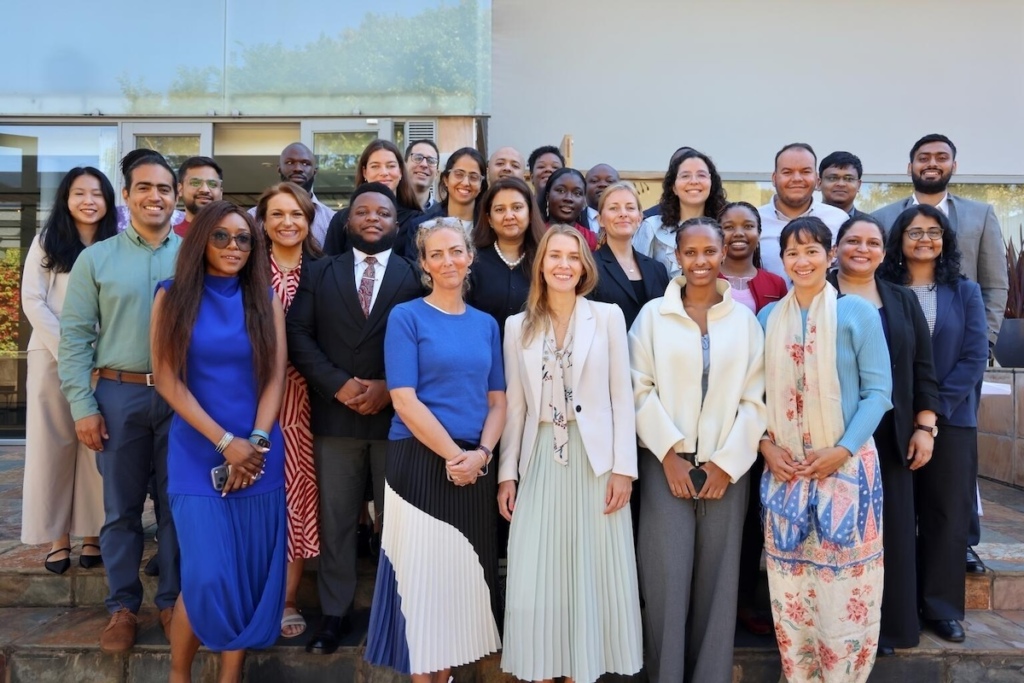
UNICEF has activated the first cohort of UNICEF Femtech Ventures, a five-year catalytic investment platform (2025-2030) backed by the Government of Sweden and Temasek Foundation. Eleven frontier tech startups from across Africa and Asia have been selected from over 1,100 applications from 85 countries to receive up to $100,000 each in equity-free capital alongside a year of tailored technical assistance.
The cohort convened in Pretoria this week, hosted by the Swedish Ambassador to South Africa, to meet investors, regulators, researchers, and peer founders, and to work with UNICEF technical leads on safety-by-design product shaping, responsible AI, and pathways to scale.
The startups apply AI, data science, and blockchain to maternal and reproductive care, safe mobility, gender-based violence response, and financial inclusion. The shortlist of 151 startups across 53 countries was 89% woman-led, with more than half of all applications coming from Africa.
"The most important innovation for women and girls is already being built - by the entrepreneurs closest to the challenge," said Thomas Davin, global director of UNICEF's Office of Innovation. "UNICEF Femtech Ventures backs them with the capital, technical support and partnerships to turn what works locally into access at scale."
The inaugural cohort spans nine countries across two continents: Dotoh (Benin) provides low-bandwidth teleconsultations and AI-enabled messaging for underserved women and adolescents. FemHealth Data Collaborative by Civic Data Lab (India) builds an evidence base for women's health decision-making using AI and machine learning. Nurtura by Doto (India) continuously monitors maternal vitals and automates risk stratification for low- and middle-income settings. VivaMama (India) delivers AI-powered postpartum support including lactation, recovery, and wellbeing guidance. Uli by Tattle (India) uses AI to detect online abuse and connect users to support networks. Bahasa Ibu by Ibu Punya Mimpi (Indonesia) creates culturally grounded data and dignified digital work for mothers. SafeRide by Esheria (Kenya) addresses women's safety in public transport through offline-first reporting. HLlama by Umbaji (Togo) is a multilingual WhatsApp chatbot delivering maternal health guidance in local languages. Feel by Luna (Tunisia) lets users record symptoms in local languages and structures them into clinical timelines. DawaMom by Dawa Health (Zambia) combines a multilingual chatbot with community health worker outreach for antenatal, postnatal, and cervical cancer prevention services. YouthShield by Kairos (Burkina Faso) detects harmful reproductive health misinformation on social media.
The program pairs equity-free capital with hands-on technical support - a model designed to de-risk future investment and channel catalytic capital toward locally built innovation in markets where systems are weakest.
"Investing in local founders solving local problems is an effective use of public funding," said Anna-Karin Eneström, Sweden's Ambassador to South Africa. "It is how African- and Asian-built innovations thrive, scale and solve some of the world's most intractable sexual and reproductive health challenges."