

Over the past few months, we’ve noticed a shift in the pitches arriving in our inbox. It used to be mostly startups reaching out - a new AI tool for embryo selection, a platform for cycle tracking, a diagnostic looking for its first clinic partner. Increasingly, it’s the fertility clinics themselves getting in touch. They want to tell us about the technology they’ve adopted, the AI platforms they’ve integrated, the partnerships they’ve signed. The story has flipped. Clinics aren’t waiting to be sold to anymore. They’re actively seeking out innovation - and making it central to how they compete.
The Adoption Problem
Across health innovation more broadly, one of the most persistent bottlenecks is adoption. Capital is an issue too - it always is - but even companies that secure funding and demonstrate strong outcomes can get stuck between pilot and scale because procurement processes, operational financing, and regulatory pathways aren’t designed to absorb what works. Solutions that prove their value in a trial setting can spend years trying to get integrated into clinical workflows. The gap between “this works” and “this is used” remains one of the most frustrating dynamics in the industry.
What makes the fertility sector interesting right now is that clinics appear to be closing that gap from their side. Rather than waiting for startups to push innovation through the door, fertility providers - from single clinics to large networks - are actively pulling it in. And they’re doing it in several distinct ways.
What This Looks Like in Practice
At the network level, established clinic groups are deploying AI across their operations at scale. As an example FutureLife, one of Europe’s largest fertility providers with clinics across 16 countries, just announced a network-wide partnership with Alife Health to adopt an end-to-end AI platform for clinical decision support - from pre-treatment planning through embryo selection. This isn’t a pilot at a single site. It’s an institutional commitment across 77,000 IVF cycles per year. For a network of that scale, AI becomes less of a marketing story and more of an operational tool for consistency and quality standardization across geographies.
IVIRMA Global in the US has gone further by building a dedicated innovation arm with its own research centers, investigators, and publication track record. When one of the world’s largest assisted reproduction networks treats R&D as a core institutional function rather than a side project, it changes the relationship between clinics and the technology companies serving them.
Other players are taking a more aggressive approach: Acquiring the innovation outright. Rhea Fertility has built what amounts to an innovation ecosystem through investment and acquisition. The company bought Embryonics for AI-driven embryo diagnostics and integrated the team into Rhea Labs, its in-house technology platform. It then acquired Tilly, a digital mental health platform for fertility patients, to embed psychosocial support across its GenPrime clinic network. And it acquired a medical tourism company to manage cross-border patient flow. The result is a clinic network that owns its AI, its patient experience tools, and its demand generation - all under one roof.
Then there are the clinics that launched with technology as their founding identity. Avenues opened in London less than two years ago and built its entire brand around what it calls “Reproductive Intelligence” - branded AI products at every stage of the patient journey, from semen analysis to egg assessment to embryo selection, plus TMRW robotic cryostorage. Ovom Care, founded in Germany and now operating in Portugal, has built what it describes as an AI-enabled hybrid fertility care model, using proprietary algorithms as clinical decision support tools for its medical team. For these newer entrants, technology isn’t a feature they’ve adopted - it’s core to their offering.
Why Fertility Is Leading This
It’s worth asking why fertility clinics specifically seem more willing to embrace innovation than providers in other areas of healthcare. A few factors stand out.
First, fertility care is largely private-pay globally, which means clinics compete directly for patients. When patients are spending thousands of dollars out of pocket, they research their options carefully - and a clinic’s technology offering is increasingly part of that decision. Innovation isn’t just a clinical advantage. It’s increasingly becoming an important patient acquisition tool.
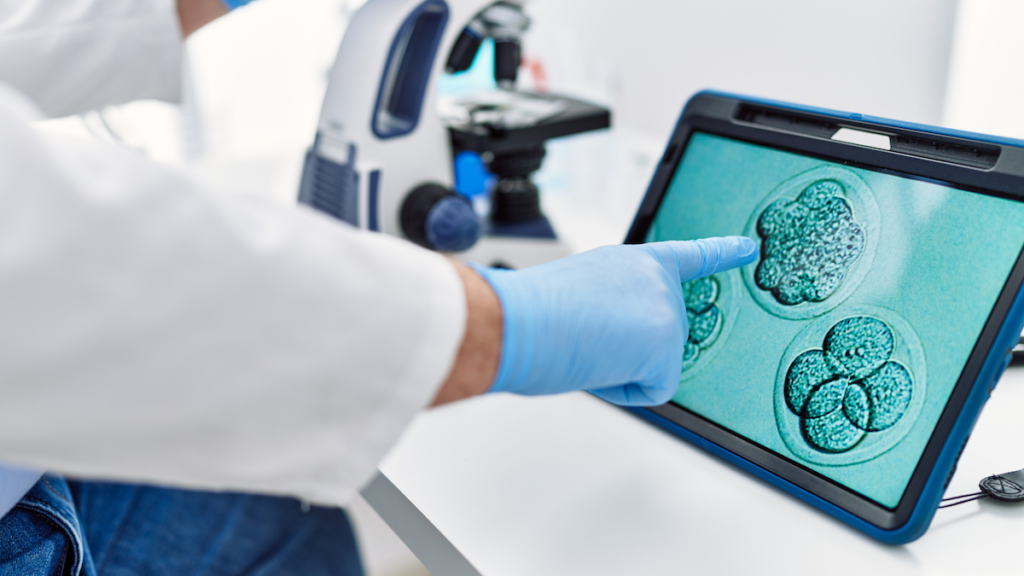
Second, the IVF lab is uniquely suited to AI. Embryo assessment, egg quality evaluation, and sperm selection are all visual, data-rich tasks where machine learning can demonstrably outperform or augment human judgment. The clinical workflows are already digital in many labs, which lowers the integration barrier. And the outcome metrics are clear and measurable - did the embryo implant or didn’t it - making it easier to validate AI performance than in many other clinical settings.
Third, the consolidation of fertility clinics into PE-backed networks has created organizations with the operational scale to deploy technology systematically. A single clinic might experiment with an AI tool. A 60-clinic network can standardize it, generate data across thousands of cycles, and negotiate enterprise-level partnerships with technology providers. The rise of clinic networks and the rise of fertility AI are reinforcing each other.
What This Signals
The fertility sector is not the only area of healthcare where innovative tools exist. Maternal care has compelling remote monitoring solutions. Menopause care has diagnostic and treatment platforms with strong evidence. Endometriosis diagnostics are advancing rapidly. But in many of these areas, adoption by providers remains slow - constrained by procurement complexity, reimbursement uncertainty, and institutional inertia.
What we’re seeing in fertility is what happens when clinics decide that innovation is not a risk to be managed but a competitive advantage to be seized. Technology companies in this space are no longer just looking for funding. They’re finding buyers and partners who are ready to integrate. That’s a dynamic worth watching - and worth replicating in other parts of the healthcare system where solutions exist but sit unused because the adoption infrastructure hasn’t caught up.