



At the start of each week we share a quick “best of” from the week that was with our Inner Circle members. What’s trending in the Femtech Insider community and beyond? We’ve got you covered! In this week's brief we talk about...
- Multimodal Biomedical AI
- A Multimodal Approach to Maternal Care
- Webinar Recordings: Innovation in Pelvic Health & Ovarian Aging
- Startup Spotlight: Aveta Medical & Urolon
- And more!
Multimodal Biomedical AI
A few days ago Nature released a new review on Multimodal Biomedical AI. In it the authors discuss how the increasing availability of biomedical data from large biobanks, electronic health records, medical imaging, wearable and ambient biosensors, and the lower cost of genome and microbiome sequencing have set the stage for the development of multimodal AI solutions that capture the complexity of human health and disease.
The Review also outlines the key applications enabled, along with the technical and analytical challenges. The authors see opportunities in personalized medicine, digital clinical trials, remote monitoring and care, pandemic surveillance, digital twin technology and virtual health assistants.
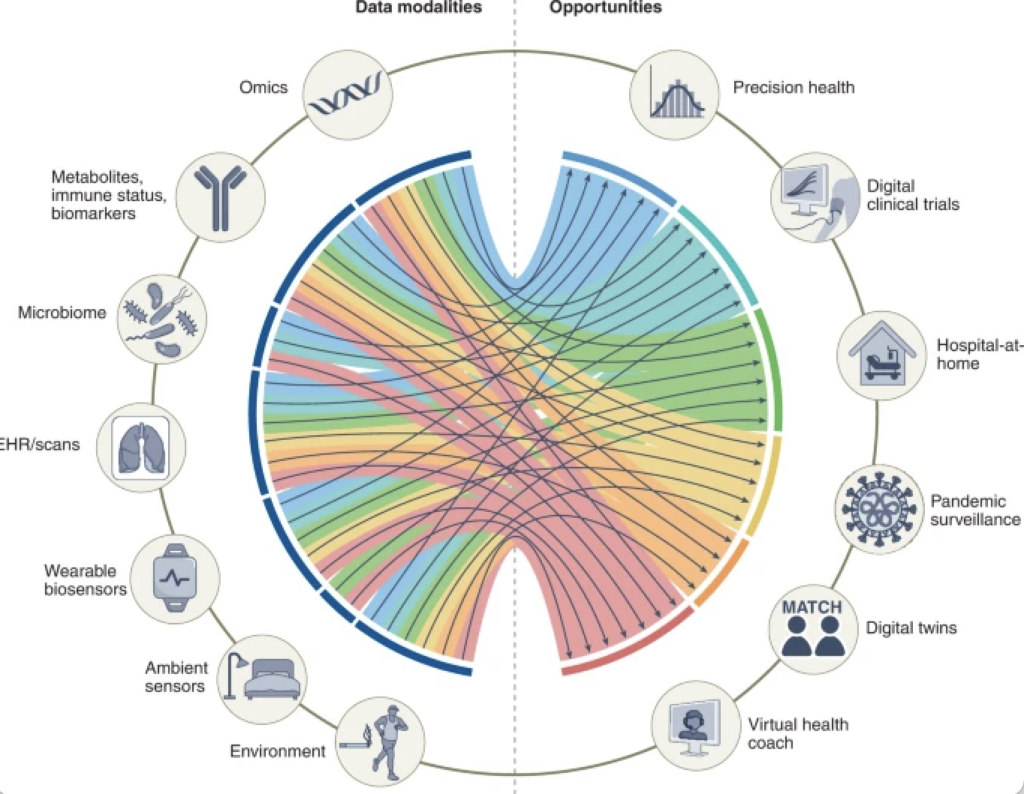
Multimodal medical AI unlocks key applications in healthcare, but also comes with a unique set of challenges around data collection, analysis and privacy.
The authors conclude that collaboration across industries and sectors is needed to collect and link large and diverse multimodal health data. To meaningfully process such high-dimensional data and actualize the many exciting use cases, it will take a concentrated joint effort of the medical community and AI researchers to build and validate new models, and ultimately demonstrate their utility to improve health outcomes.
A Multimodal Approach to Maternity Care
Pregnancy programs that move from a strictly medical focus to one that included behavioral health and social determinants of health are starting to see more adaption and success. This whole-person approach addresses anxiety, diet, substance use disorder, postpartum depression, and other medical factors.
Early research unsurprisingly shows that integrated programs that identify and engage mothers as early as possible in various ways provide the best opportunity to reduce premature birth rates, support healthier infants and deliver better outcomes.
A new report recently released by Progeny Health now builds on these findings and shares some recommendations with regards to the design of successful integrated maternity programs that use a multimodal approach.
👉 An integrated maternity program uses a multimodal approach includes:
- Early member identification and enrollment
- Risk stratification using comprehensive assessments
- App-based support to drive engagement and healthier pregnancies
- Telephonic case management that includes both prenatal and postnatal support
- Support interventions to solve social determinants of health and ensure health equity
- Extended care through the first 12 months after delivery for mom, baby, and family
👉 Clinical components should include:
- Comprehensive and ongoing assessments
- Individualized care planning and coordination
- Sophisticated maternity case management technology
- Remote patient monitoring
- Specialized medical expertise to ensure quality of care standards
- Most importantly, a dedicated maternity nurse and/or social worker who can build a personal, trusted relationship with the pregnant member to address concerns, support behavioral change, and reduce risk factors.
Overall Progeny's new report provides a useful framework for the design of integrated care programs - in maternity care and beyond. Worth a read!
Startup Spotlight
Wanna know which startups get us excited these days? Below are a few of our recent (femtech-healthtech-ish) discoveries. 👀
Aveta Medical has developed a hormone-free, monthly solution that treats the underlying condition of vaginal atrophy.
Urolon is a bioresorbable, non-permanent filler that is completely removed from the body over time and can be used to treat stress urinary incontinence (SUI).


