



Every Monday we share a quick “best of” from the week that was with our Inner Circle members. What’s trending in the Femtech Insider community and beyond? We’ve got you covered! In this week's brief we talk about CooperCompanies, Cook and Postpartum Hemorrage, plus...
- If Health Systems Could Talk...
- Startup Spotlight 🌟
- And more!
| Why Cooper's Plans to Buy Cook's Reproductive Health Business Make Us Think about Postpartum Hemmorhage |
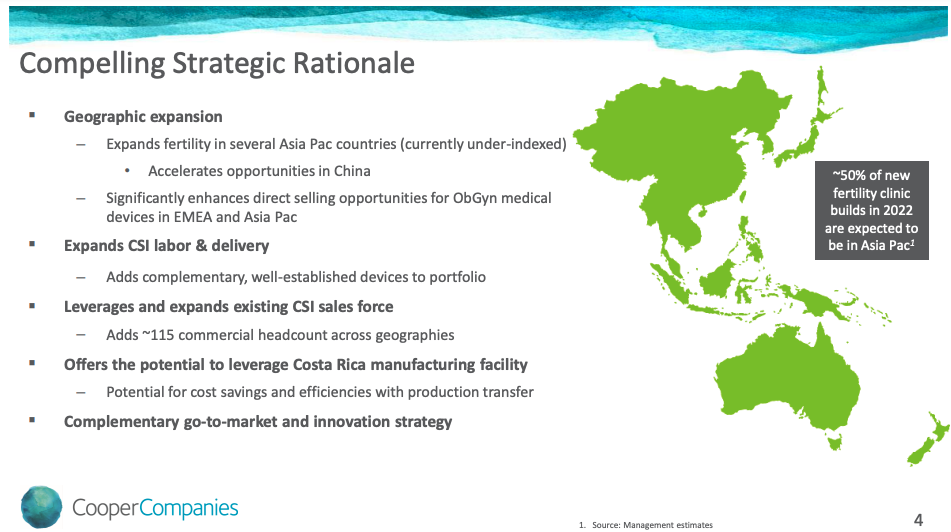
| Earlier this month CooperCompanies announced plans to acquire Cook Medical's Reproductive Health business for $875M. Over the past couple of days we dug a little deeper into the terms of the deal and today we'd like to share some findings and also why we are paying more attention to innovation in postpartum hemmorhage these days. 🤑 The Deal Cook Medical Reproductive Health manufactures and sells minimally invasive medical devices focused on fertility, obstetrics and gynecology. 2021 sales were at around $158M (73% fertility &27% ObGyn) with 17% YoY growth. Cook's product portfolio is complementary to CooperSurgicals. When reviewing the investor presentation about the deal Cooper shares the following strategic rationale: 👇 |
🧐 So what exactly is part of Cook Medical's Reproductive Health business?
As mentioned Cook's Reproductive Health Business is home to two medtech product lines: One dedicated to fertility and one dedicated to OB/GYN.
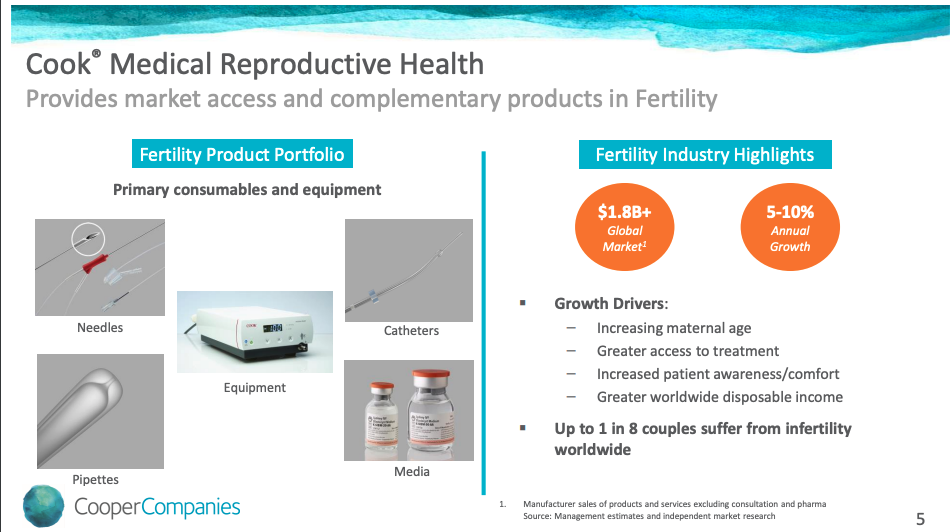
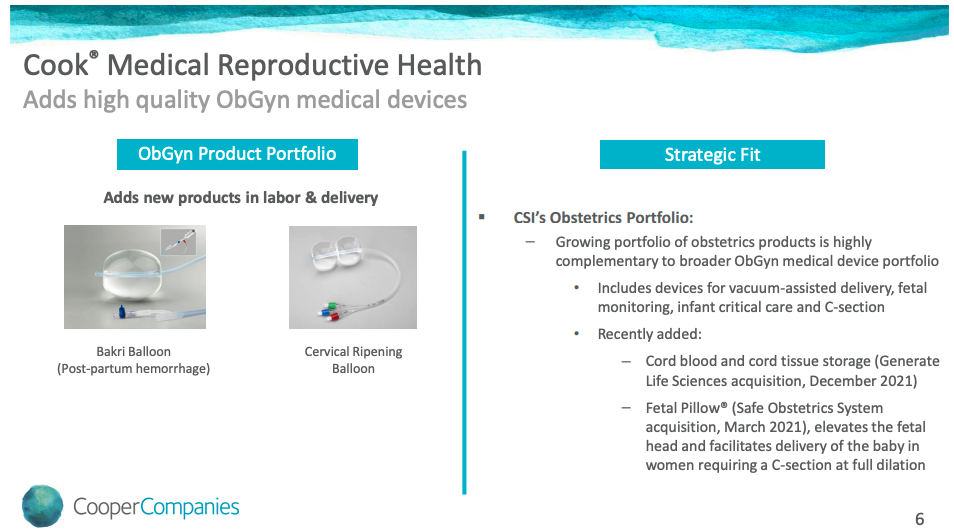
And although fertility is the larger business for Cook as of right now, the OB/GYN business, more specifically the BAKRI balloon aka standard of care for postpartum hemorrhage (PPH) in many maternity wards, caught our attention. Why? Because last year saw another noteworthy acquisition when Organon bought Alydia Health, the company behind the Jada, a uterine suction tube also used in the treatment of PPH.
PPH is yet another, rather unknown women's health condition, that we all should probably know a little more about. Because it affects a large number of women giving birth and innovation in this space is potentially life saving. And because we know: Underserved spaces make for great business opportunities.
Curious? Wanna learn more? Great! Read on! 👇
🤔 PPH? What's that?
From an upcoming Femtech Insider article: Every second 4 babies are born somewhere in the world. And every 4 minutes a woman, who just gave birth dies of postpartum hemorrhage (PPH).
PPH refers to excessive vaginal bleeding following the birth of a baby. It’s the leading cause of maternal mortality in low-income countries and the primary cause of nearly a quarter of all maternal deaths globally. About 80% of postpartum hemorrhages occur during the so-called third stage of labor when a woman’s uterus is unable to shrink fast enough to close off the open blood vessels left after the placenta removes itself from the uterine wall. This is called uterine atony and it is the most common cause of PPH.
Once identified, management of PPH usually includes uterine massage, administration of uterotonics, application of uterine compression sutures, and intrauterine packing techniques to help stop the bleeding. In severe cases of PPH a hysterectomy is the final option. The quicker the bleeding can be stopped, and the less blood a woman loses, the better her chances are for successful non-surgical treatment.
Established solutions to reduce PPH blood loss are Cook's BAKRI (see above), Alydia Health's Jada (see above) as well as the a non-pneumatic anti-shock garment (NASG) (more here) used in the developing world to stabilize women until treatment is available.
🔮 So...
In summary: PPH. A leading cause of maternal death. Only few solutions on the market. Definitely a space to keep an eye on, and we'll be sharing more about other (potentially game-changing) solutions we see.
So stay tuned... More on this soon. 🔜
💬 If Health Systems Could Talk...
This week we stumbles upon an interesting report, that was released back in October 2021 and highlights the state of primary care in different countries. "If Health Systems Could Talk: Illuminating the Vital Signs of Strong Primary Health Care" was authored by PHCPI, a partnership that includes the Gates Foundation, World Bank, WHO, Unicef, Ariadne Labs & Results for Development and attempts to create a standardized framework to measure the quality of primary care in different geographies.
➡️ Why primary care matters
"The story of any health crisis often begins with a common dilemma: someone, somewhere, starts to feel sick. In certain stories, the source is an infection or heart attack; in others, it’s the first symptoms of cancer or depression. In December 2019, it was COVID-19.
While we can’t predict every health challenge that will arise, people’s concerns in these moments often revolve around familiar questions: Should I seek help? Is there a health facility nearby? How much time, money, or effort will it take? Can I trust the staff and services? Will they help me get better?
Strong primary health care is the foundation of strong health systems—ensuring all people can get the right care, at the right time, right in their community.
The ongoing COVID-19 pandemic is a stark example of what happens when this foundation is not strong enough. It should also be a wake-up call for leaders everywhere to invest in primary health care as a priority—now."
➡️ What is the report about?
In the report it is argued that strong primary care is measurable and thus achievable.
One of the most important lessons from the first 23 Vital Signs Profiles is that it is possible to define and examine the strength of primary health care in a rigorous, standardized way. This is something that could not be said with confidence at the start of the Sustainable Development Goal era, and should help dispel any myths that primary health care is too difficult for leaders to define, measure, or prioritize.
That said, primary health care remains a complex, multi-faceted concept that could never be summarized with a single number. By pulling data together from diverse sources and distilling this information in an accessible way, the Vital Signs Profile helps leaders visualize and act on the main strengths and weaknesses of primary health care in their health system.
Wanna learn more? Read the report.
Startup Spotlight
Wanna know which startups get us excited these days? Below are a few of our recent (femtech-healthtech-ish) discoveries!
👉 Fabric Health: A startup that turns laundromats into doctor's offices.
👉 K'ept Health: A telederm startup that understands all skin tones.
Know of a company that should be on our radar? Let us know!


