


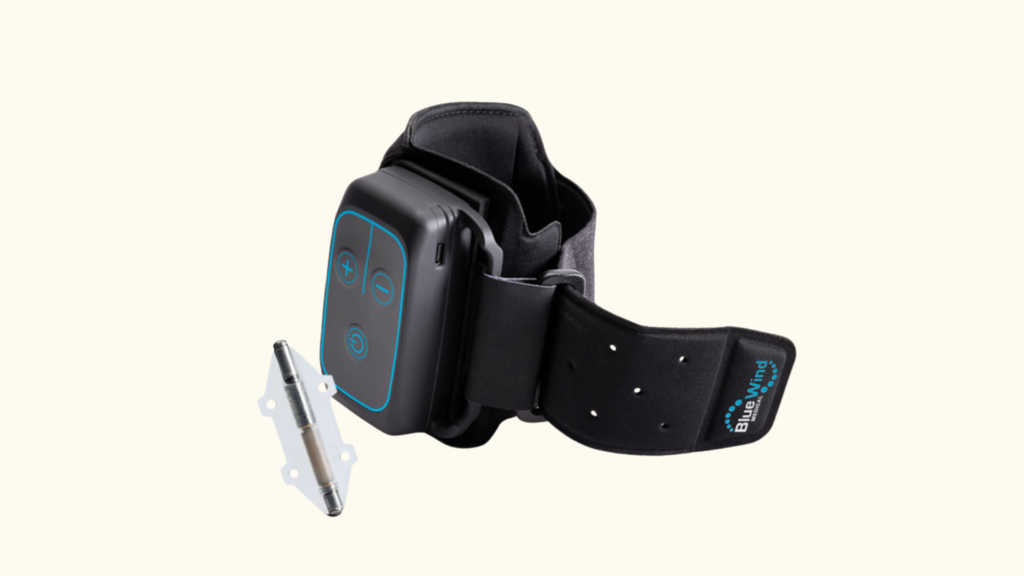
BlueWind Medical has received FDA 510(k) clearance for an enhanced version of its Revi wearable, the external component of its implantable tibial neuromodulation (iTNM) system for urgency urinary incontinence (UUI).
The Revi System consists of a small implant placed near the tibial nerve and a battery-operated external wearable that activates the device. The updated wearable features a redesigned interface with what the company describes as a smarter, more user-friendly design while retaining three-button control.
BlueWind has been developing iTNM technology for UUI since 2010, evolving it from an early concept into an established therapeutic option. The Revi System is the first and only implantable tibial neuromodulation device activated by an external wearable to receive FDA clearance for UUI.
The system is implanted in a single minimally invasive procedure under local anesthesia and does not require a trial phase. Patients can adjust therapy settings through the wearable to adapt to changing symptoms. Unlike other neuromodulation therapies, physicians can use their discretion on whether patients should first try more conservative treatments before using Revi, rather than mandating step-therapy.
In the company’s two-year OASIS study, 79% of patients achieved a 50% or greater reduction in UUI symptoms, and 97% reported satisfaction with the treatment. The study reported no device- or procedure-related serious adverse events, no device migrations, and no revision procedures.
“We are proud to lead the next generation of technology for the treatment of urgency urinary incontinence,” said Kerry Nelson, CEO of BlueWind Medical. “BlueWind has been at the forefront of the field, pioneering implantable tibial neuromodulation for UUI. Our strong clinical evidence and our focus on patient comfort and satisfaction show that when patients can personalize their therapy, outcomes improve. The enhanced wearable continues that philosophy by making therapy easy to use, adaptable to each patient’s lifestyle, and supportive of long-term use. All of this helps patients achieve durable symptom relief and overall satisfaction.”