

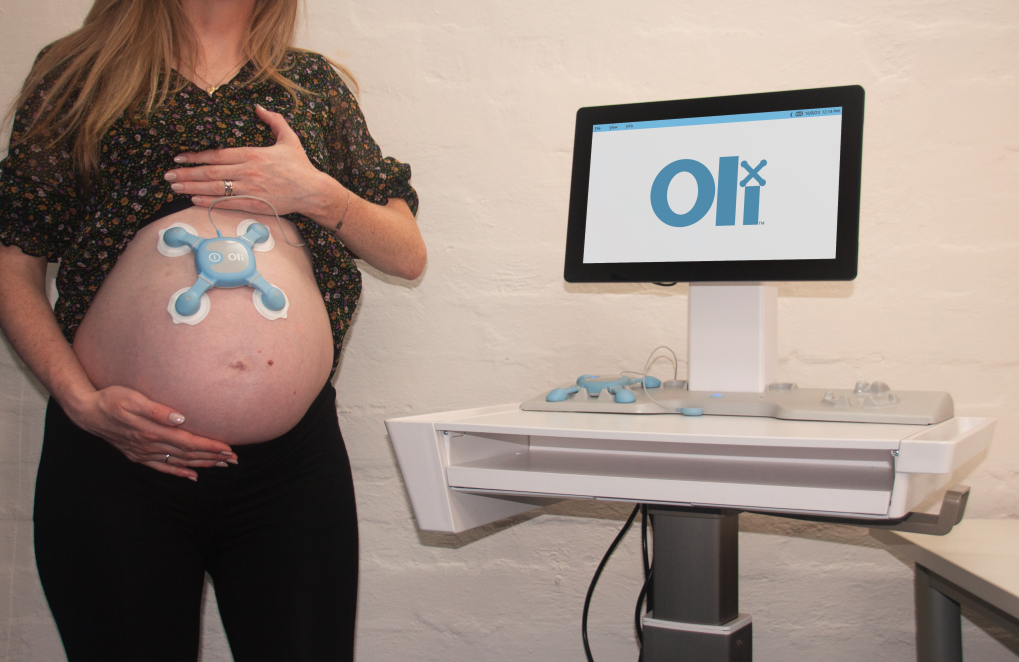
Oli, the Australian wireless wearable device that monitors maternal and fetal signals during labor, has raised $6.5 million in a Series A3 round backed by Scale Investors, Clare Ventures, and The University of Sydney. To date, Oli has raised $13 million in private capital alongside more than $9.5 million in non-dilutive grants.
The funding will support completion of pivotal clinical trials underway across seven sites in Australia and the United States, advancement of regulatory submissions with both the TGA and FDA, establishment of manufacturing operations in Australia, and preparation for commercial launch.
Oli captures millions of physiological data points across 10 biosensors – maternal and fetal simultaneously – through a wireless wearable that doesn’t interrupt movement or the natural progression of labor. Its patented Predictive Maternal-Fetal Signal technology translates raw inputs into live clinical signals that update as labor progresses, identifying patterns that precede serious complications. The platform aims to analyze up to 15 conditions including postpartum hemorrhage, fetal distress, stillbirth risk, and labor progression.
The initial clinical focus is postpartum hemorrhage, where early clinical simulations indicated Oli could improve clinical response times by up to 58% and reduce severe interventions such as hysterectomies and blood transfusions by up to 50%. Oli’s technology is designed to predict PPH onset before it begins – at least one hour before birth and in some cases up to nine hours prior – compared to today’s approach where the condition is typically diagnosed only after significant blood loss has occurred.
“In birth rooms today, the monitoring meant to protect the room is failing the people in it – losing contact with mother and baby, misfiring, and demanding constant attention from the team it was supposed to free,” said CEO Tara Croft. “Oli was built for everyone in the birth room. It signals what’s coming and when it’s time to act, before an emergency arrives.”
Oli was founded in 2018 by mechatronic engineer Dr. Sarah McDonald following the traumatic birth of her second child, to address a critical gap: Despite advances across healthcare, maternal and fetal monitoring has remained largely unchanged for over 60 years, with clinicians still relying on the same three rudimentary biomarkers using retrospective information.