



First Things First: Why Do We Need Innovation in Contraception?
Contraception is far more than a healthcare niche; it's a transformative instrument with broad societal impact.
It enables more sustainable and healthy family structures through family planning and has a profound influence on women's empowerment by allowing for greater educational and career advancements. In terms of health, it can significantly impact both maternal and child health and from a broader perspective, effective contraception has a cascading positive impact on public health and healthcare resources.
Ensuring access to contraception can also have a big economic impact and even has the power to transform societal norms around gender roles and reproductive responsibilities.
Challenges in Contraceptive Care
Despite its importance, the contraceptive sector is fraught with challenges. On the medical front, existing methods often come with a range of side effects and long-term implications that are not yet fully understood, largely due to a lack of expansive research.
Social challenges include cultural resistance to certain contraceptive methods and pervasive stigmatization and misinformation, can hinder adoption rates.
Economically, the sector grapples with issues of affordability and access to quality contraceptive options for many, as well as broader societal costs when access is limited or denied.
Despite these challenges, a pivotal shift in the landscape is fueled by increasing awareness and demand for contraceptive options enabled by advancements in both medical and technological fields, and a societal attitude that's gradually becoming more accepting of contraception, which is reflected in consumer preferences.
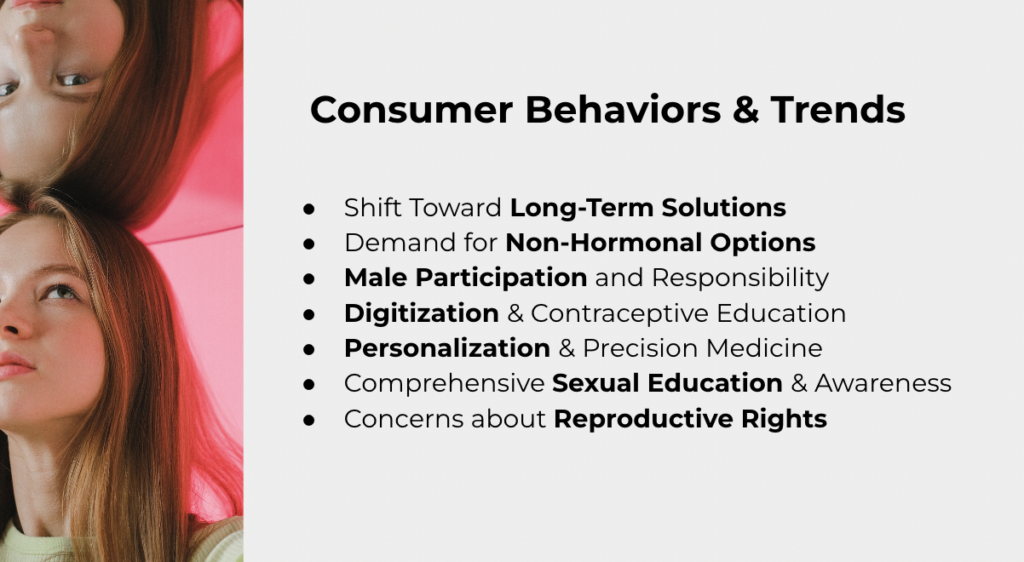
Emerging Consumer Preferences
Consumers are becoming increasingly informed and empowered, driving new trends in the market.
They are leaning towards long-term solutions and showing a rising demand for non-hormonal options that minimize side effects and long-term impacts. There's also a strong push for greater male participation and responsibility in contraception, calling for a more equitable distribution of contraceptive duties between genders.
Technology plays a key role as consumers look for digitized contraceptive education and solutions. The growing field of personalization and precision medicine is also beginning to extend into contraceptives, tailoring solutions to individual biological and lifestyle needs.
Additionally, there's a stronger emphasis on comprehensive sexual education and awareness, alongside a heightened concern about reproductive rights in the current social and political climate.
Innovation in Contraceptive Care
If the future of this sector intrigues you, innovation is occurring along several key fronts.
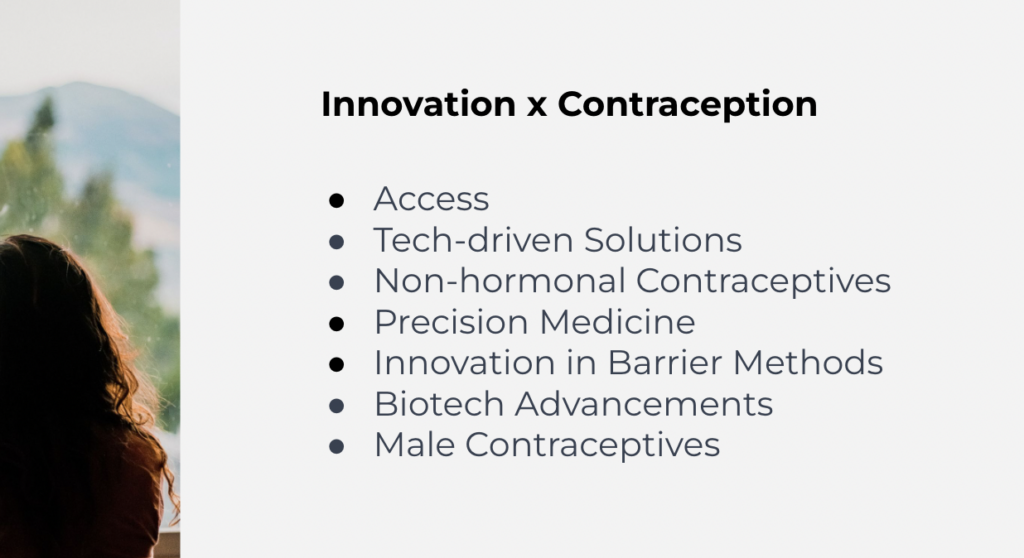
We're seeing concerted efforts to improve global availability and affordability to ensure access to contraception for all. Tech-driven solutions are also coming to the fore.
In terms of product offerings, more and more non-hormonal contraceptives are emerging to diversify the options available. As mentioned earlier precision medicine is paving the way for contraceptives that can be customized to individual health profiles. Traditional barrier methods (aka condoms & co) are also being rethought and redesigned through innovative engineering and with a special focus on sustainability.
Biotechnological advancements are adding an exciting layer to the field, promising revolutionary products that may redefine contraception. One of the most exciting innovations worth mentioning in this context: Male contraceptives are beginning to surface, offering men more participation in the family planning process.
So Who's Innovating?
Fortunately, more and more entrepreneurs across the healthcare ecosystem are stepping up to the challenge and driving innovation in the contraception space. If you’re curious, who we believe is doing pioneering work in the space, catch up by re-watching last week’s webinar below.
Webinar Recording: Innovation in Contraception


