

Amber Vodegel built Pregnancy+, which became the number one pregnancy app globally with 150 million downloads. She sold it to Philips in 2017, stayed for five years, and left in 2023. Now she’s back with 28x, a free period tracking and women’s health app that just launched with £1.2 million in funding from the Philips Foundation and 40 mission-driven philanthropic angel investors.
The difference this time: no cloud servers, no subscriptions, no data collection. The app runs entirely on-device.
“We do not store any user data on our servers – because we do not have any servers,” Vodegel said. “Data cannot be leaked, and if someone subpoenas the data, we have no data to hand over.”
28x: Building for the 80%
The insight that shaped 28x came from watching where innovation in women’s health was going.
“Innovation was increasingly reaching a very specific kind of woman – one who can afford a subscription or a supplement stack or a smart ring,” Vodegel said. “That is a very small slice of the world. I wanted to build something for the other 80%.”
The gap in healthy life years between the wealthiest and poorest women continues to grow. Vodegel argues the idea that technology will trickle down to the most vulnerable is not playing out.
“No one is working on minority languages because they are not profitable. No one is building low-literacy content because those users do not convert to paid subscriptions. The incentives are wrong.”
Before building anything, Vodegel spent a year talking to over 300 experts across the US, UK, Europe, Pakistan, Indonesia, and Brazil – seven or eight calls a day, testing the concept and refining the model. Two core decisions came out of those conversations.
The first was funding. Vodegel had assumed she would raise venture capital, but realized the incentives could never align with her mission.
“VCs want a 10x return, and whether you like it or not, that means users become the product,” she said.
The second was architecture. She had originally planned to use heavy encryption, similar to other privacy-focused apps. But technical advisors kept breaking those approaches – anything on a cloud server can ultimately be accessed. So 28x went fully on-device.
“The architecture is the privacy policy,” Vodegel said. “Any app can promise privacy, but if you do not build it into your architecture, it does not hold up.”
The Wikipedia Model
The on-device architecture has a secondary benefit: it eliminates incremental infrastructure costs. Whether 28x has one user or 100 million, the infrastructure cost stays the same. That enables a business model modeled on Wikipedia – free to use, sustained by donations. The model relies on scale, but Vodegel has done it before.
The round closed in September 2025 and was 3x oversubscribed. The majority of the 40 angel investors are women – a deliberate choice. When Vodegel first looked at her cap table, it was almost entirely men, so she spent additional time bringing women investors on board.
The next round will be non-dilutive – philanthropic donations rather than equity investment.
What the App Does
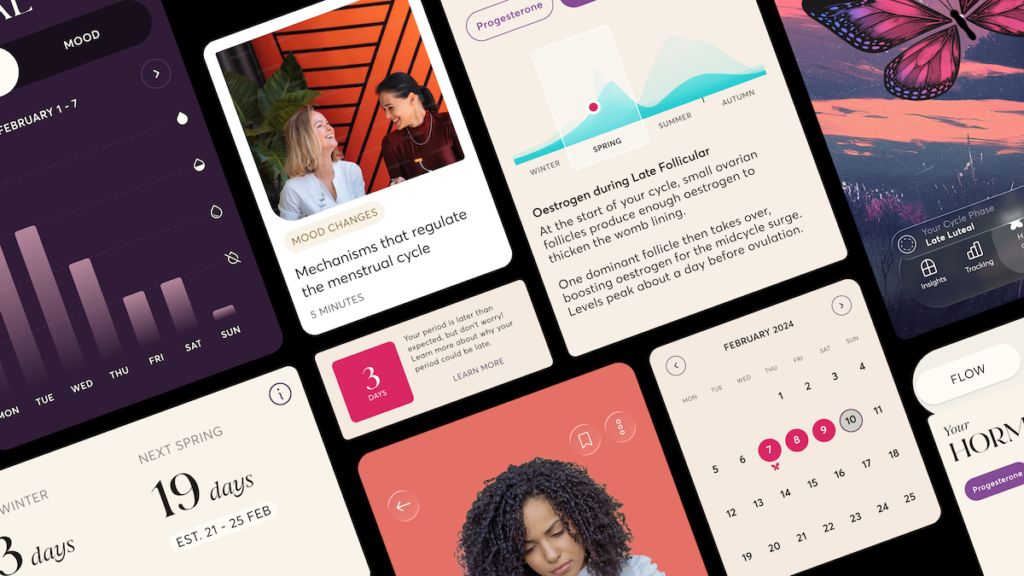
28x will cover 100 health topics with clinically validated content and will eventually support users from ages 8 to 50. The app offers three reading levels to accommodate different literacy needs and will launch in over 30 languages over the next two years, including minority languages that are not commercially viable for most apps.
Users can also specify what they do not want to see – someone who has just had a miscarriage can block fertility content, for example.
The interface is built around a butterfly that encodes cycle data in its wing colors, designed for users in cultural contexts where periods are stigmatized. The number of dots indicates days until the next period; the wing color indicates cycle phase.
“Not everyone is comfortable with a screen that says period day two in big letters,” Vodegel said. “You can open the app anywhere – on the train, in a meeting – and see a butterfly. Only you know what it means.”
The app is now available on iOS and Android. The current release includes cycle tracking, health content, and the privacy architecture. More features will roll out over the next six months, including on-device AI that processes queries without pinging external servers.
If the model works, Vodegel has pledged to open-source the architecture for other health apps – mental health, cancer care, weight management, diabetes.
“Women’s health is where we are starting, but the need for private, free health tools is everywhere,” she said.